


FSB Fluorine Plastic Alloy Pump - Classification and Characteristics
FSB fluorine plastic alloy pump is a type of chemical centrifugal pump that is widely used in the chemical industry to transport corrosive liquids. It is made of fluorine plastic alloy material, which has excellent corrosion resistance and can withstand strong acids, alkalis, and oxidants. In this article, we will discuss the classification and characteristics of FSB fluorine plastic alloy pump.
Classification
According to the structure
FSB fluorine plastic alloy pump can be divided into single-stage and multi-stage centrifugal pumps.
According to the connection mode
FSB fluorine plastic alloy pump can be divided into flange type and clamp type.
According to the sealing method
FSB fluorine plastic alloy pump can be divided into mechanical seal type and packing seal type.
Characteristics
High efficiency
FSB fluorine plastic alloy pump has a streamlined design, which reduces the resistance of the fluid flow and increases the pump's efficiency.
01
Low noise
FSB fluorine plastic alloy pump has a low noise level, which creates a comfortable working environment.
02
Easy maintenance
FSB fluorine plastic alloy pump has a simple structure, easy disassembly and assembly, and convenient maintenance.
03
Corrosion resistance
FSB fluorine plastic alloy pump is made of fluorine plastic alloy material, which has excellent corrosion resistance. It can transport highly corrosive liquids such as sulfuric acid, hydrochloric acid, nitric acid, aqua regia, and various organic acids.
04
High temperature resistance
FSB fluorine plastic alloy pump can transport liquids with a temperature range of -20°C to 120°C, and the pump body can withstand a maximum temperature of 150°C.
05
In conclusion, FSB fluorine plastic alloy pump is a highly efficient, corrosion-resistant, and low-noise centrifugal pump that is widely used in the chemical industry. Its excellent performance makes it a popular choice for transporting corrosive liquids.
Use Installation With Notes
The pump and motor shall be inspected before installation. All parts shall be in good condition and there shall be no sundries in the pump.
Place the pump horizontally and connect the inlet and outlet pipes and power on. Finally, the coupling is dismounted by hand. Check for rubbing. The installation ends when the rotation is easy and even.
Plastic alloy pump steel degree is worse than metal, so the weight of the pipeline can not be directly pressed on the pump body, the injection, export pipeline should be added to support. High head of the pump at the exit should also be installed back check valve in. In case of sudden stop of water hammer damage.
All joints must be sealed in. In order to prevent air leakage, fluid affect the pump performance.
When pout or abnormal sound is found during operation, stop itoperation. Stop immediately to check the cause. Therefore, health can be eliminated before work.
Starting And Stopping
- Fill the pump with full of liquid (primer).
- Juniper check whether the oil level in the bracket oil chamber is within the specified range.
- Check the motor running direction. Adjust the rotation mark of the pump.
- Close outlet valve and pressure gauge cock.
- Start motor. Open pressure gauge cock. Slowly open the outlet valve when it is pressed
- When it is important to stop, first close the outlet valve and then cut off the power supply. Stop adjusting the size of the outlet valve when the gauge pointer indicates the desired position.
Disassembly And Installation
The disassembly of the pump
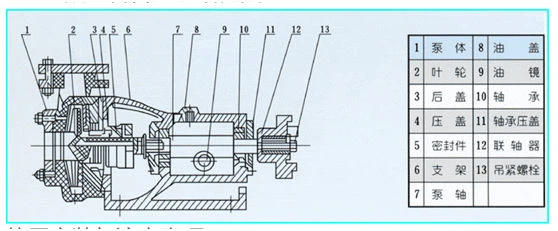
- The pump is connected to the motor with a claw coupling. Before removal, loosen the 4 connecting bolts between the bracket and the base. Detach pump from motor.
- Loosen the connecting bolts on the back cover of the pump body. Tap the pump body with a wooden handle to detach.
- Loosen the lifting bolt connecting the vane shaft to the pump shaft with Morse taper in the coupling.
- Loosen the mechanical seal movement! Without fixing the screws, tap the central hanging bolt of the coupling with a wooden hammer, loosen the blade shaft and pump shaft's Morse taper and pull out the moving ring of the impeller, rear cover and sealing parts. Loosen the back cover capping screw. Take out the static break.
- Loosen the pump shaft around the gland screws. Take out the pump shaft, bearings, and clean the bracket oil chamber.
Parameters
| Flow rate | Q=5~220 (m³/h) |
| Total head | H=10~45 (m) |
| Speed | n=2950 /1450rpm |
| S.g. | γ ≤0.5 |
| Temperature | T=0~120℃ |
| Pump diameter | 32~200mm |
Features
■The fluid is not delivered directly by the impeller,the fluid gains the energy from the vortex generated by the rotating impeller.
■Non-clog performance on pumping fluids with big particles.
■Intertwine free performance on pumping fluids with fibers and suspending materials.
■Non-stop performance on pumping fluids with air.
■The biggest solid in the fluid can be as big as 80% of the pump diameter,and the weight density is up to 60%.
Structure
■Horizontal,single stage cantilever structure.
■Axial suction and radial discharge,and the discharge can be rotated 90° to horizontal direction.
■Soft packing seal with high pressure shaft sealing water during operation.
■Directly driven by the motor through the couplings.
■Simple structure and easy maintenance.
Hot Tags: fluorine plastic alloy pump, China fluorine plastic alloy pump manufacturers, factory, Fluoroplastic Centrifugal Pump, Horizontal Axial Flow Pump, Mixed Flow Pump, Self priming Corrosion resistant Ss Pump, Vertical Axial Flow Pump, Vertical Submerged Chemical Pump


